 |
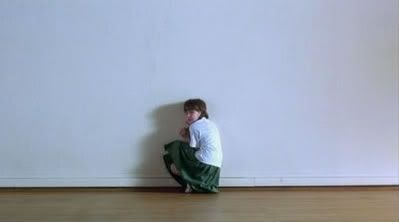
| Code inconnu, from opening shot. |
Watching the Haneke, I was struck by the way, in all his films, it almost seems like the effect he is trying to achieve is a constant modification, sometimes overturning, of the assumptions that we make to fill in the inevitable holes that are left by any work of narration. For instance, there is the journalist in Code Unknown. We begin by imputing to him a certain ethical integrity and courage for traveling to a war torn country to spread the news about the war. Later, when we see his refusal to get involved with the fact that his neighbors are severely abusing their young daughter, we are forced to reconsider his integrity and motivation for doing something so personally dangerous. Finally, near the end of the film he is shown stopping into a beauty salon to buy some kind of hair product - the camera remains outside but we are allowed to watch the brief, seemingly trivial interaction. Why are we being shown this? We have to admit, at this point, though of course we believe that this man, like any other, has to buy hair products; but there is a sense in which we hadn't made this assumption - we simply hadn't thought of him in that light. Haneke's realism - keeping the camera rolling during such an errand - is at odds with our need to interpret everything as a symbol, to 'decode' it accordingly: there is a temptation to allow this episode to indicate some kind of vanity, and as such to allow it to be part of an on-going characterization scheme, here building off of his self-interested refusal to get involved with the abusive parents next door. Then again, he's just buying shampoo, something everyone does; why does it have to accuse his character? But then again, this entire scene happens after a seemingly unpleasant encounter for the immigrant beggar woman character, though we too are left in the dark about what happened. Certainly his preoccupations are less dire than hers. But still, these characters have no real relation to each other - are our - i mean mine and your - characters impugned because there are unknown people out there suffering worse than us? Or does the accusation only take place in art - ie., when the director chooses to juxtapose the two - journalist and beggar - in a way to bring the gap out explicitly? But if we go this way, aren't our characters too, as viewers, impugned by being brought into juxtaposition with the directors juxtaposition? After all, we enter intimately into their collusion by viewing the whole thing! These questions are raised over and over again in his films because Haneke's camera seems to intrude and cut out of his characters lives without regard to what's necessarily 'important' or 'indicative of character'; for another example, think of the laughing fit that Binoche's character has at the post-production session for the film she is making. Why is it important? Should we interpret it indicating some kind of lack of sincerity in the more gravely serious scenes that occur just minutes apart from the laughing fit? Or is it just a moment in her day, she's overworked and she's a bit giddy? Suffice it to say, we cannot fill in the gaps or decode the symbolism because the code is unknown. What's most remarkable is not that Haneke's works refuse to provide us with the usual code to decipher characters, but rather that Haneke's work actively refutes our long-ingrained attempts to decode what we're seeing according to our wonted modes: he slowly reopens all the gaps that we unreflectively fill in from the get go. Think again, of the troubling opening sequence - the little girl backing towards the wall, frightened, watching someone beyond the camera; this is overturned when the shot reverses and we see she is in some kind of class, playing some kind of game where the other deaf children try to guess what she's trying to say; we are allowed to forget about her for a long time - perhaps altogether - if not for the return of a deaf boy playing the same game near the end. Now we have to make sense of this: why are these characters included? Does it just bear a metaphorical relation to the story - that they're both these games of guess the meaning? Or are we supposed to conclude that this little girl is the abused girl? If so, then clearly the meaning of this game, and the frightened look in her eyes, takes on a more sinister significance.
Once you see that this is what he's doing, you can't stop seeing it, ie., this tension of ambiguity, between our attempts to decode everything as a symbol, with it's attendant assumption that somehow the camera 'knows' what to capture in order to reveal the significance in a character or event, on the one hand, and the "realism" that the photographic medium is supposed to be so apt to achieve: we're seeing what happened then and there, and what ever meaning we find is imposed by us, the viewer, in our attempt to tidy everything up into some perhaps slightly more complex or sophisticated or qualified version of the hero/villain dichotomy. At this point, the doubt raises itself - not that the code is 'unknown' (which is a mere, though potentially unsolvable, epistemological problem) but that there is no code (which is an ontological problem); why is there no code? Because there is no entrance. And there is no entrance because the transpiring of the world is shut up tight in a chaos that defies our meager attempts at narrative sense-making. Or maybe the journalist is just an asshole.
As I watched this film, and recognized the ever-shifting layers and boundaries of sense that infringed on each other and indeed on my attempts to understand, I couldn't help but think that Haneke's films are the perfect subject for a reader-response critical approach. It is as though he writes so as to flout the reader's natural responses, and to leave him in a place where he cannot constitute a unified aesthetic object. This passage was too fitting not to quote at length:
"Communication in literature, then, is a process set in motion and regulated, not by a given code, but by a mutually restrictive and magnifying interaction between the explicit and the implicit, between revelation and concealment. What is concealed spurs the reader into action, but this action is also controlled by what is revealed; the explicit in its turn is transformed when the implicit has been brought to light. Whenever the reader bridges the gaps, communication begins" - Wolfgang Iser


